Building Ultra Frog: My Journey Creating an AI-Powered Screaming Frog Alternative
Why I built Ultra Frog SEO Crawler—a high-performance, open-source alternative to Screaming Frog infused with MCP servers, Mistral AI, and real-time sitemap validation.
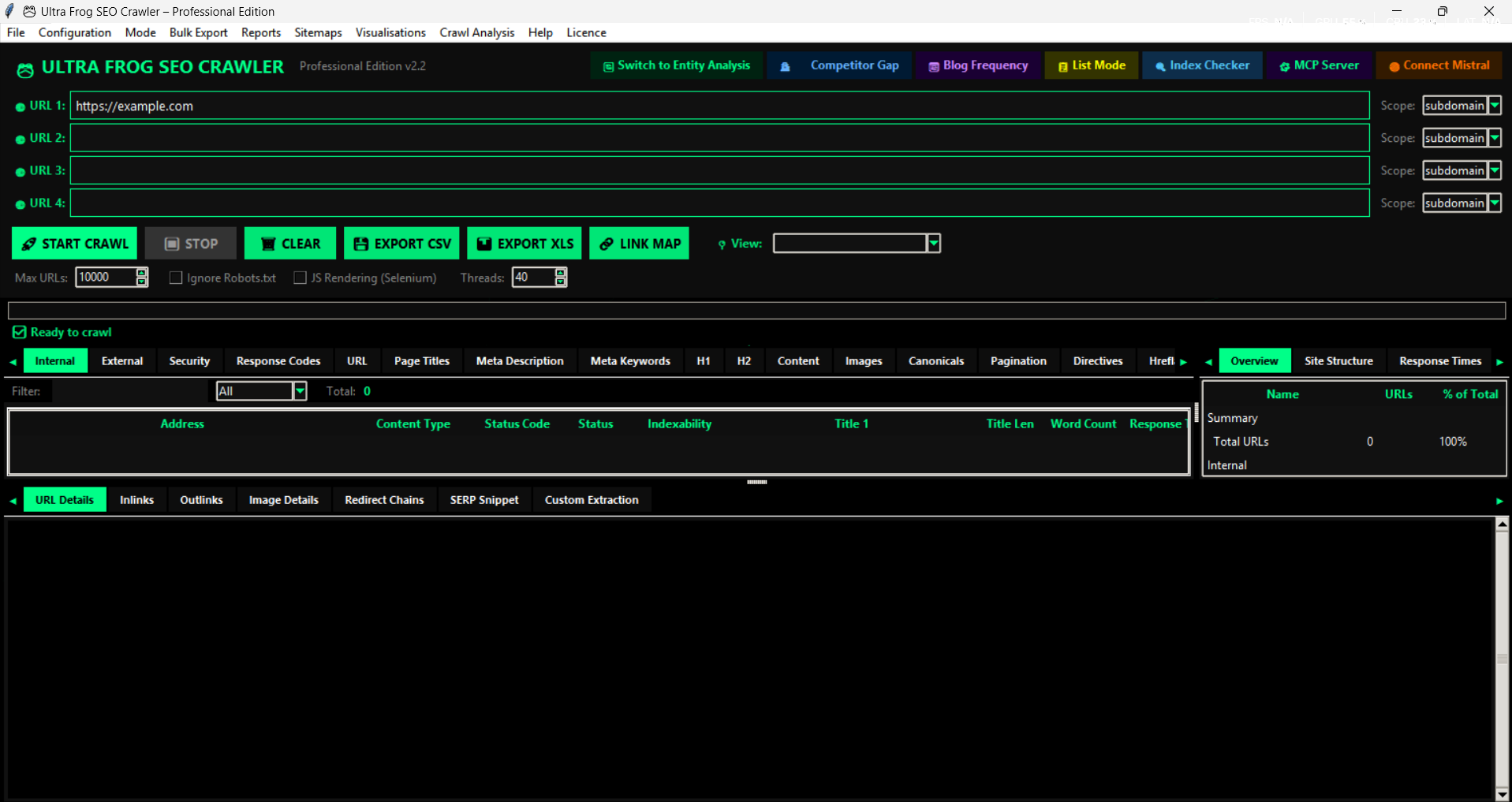
For years, Screaming Frog has been the undisputed industry standard for desktop SEO auditing. It is fast, reliable, and highly functional. However, as search behavior shifts from traditional keyword matching toward Generative Engine Optimization (GEO) and AI-driven search bots (like GPTBot, ClaudeBot, and Perplexity), I realized that our auditing tools need to evolve.
Traditional crawlers extract raw data, but they lack a native brain. They do not easily hook into the local LLM toolchains that developers use, nor do they offer real-time conversational assistance or AI-directed troubleshooting.
That is why I built Ultra Frog SEO Crawler.
I wanted to design an open-source, desktop-based alternative to Screaming Frog that fits perfectly into the modern AI-agent stack. In this article, I will share the architectural journey of building Ultra Frog and walk you through its core features—including Model Context Protocol (MCP) server integration, headless Selenium-based rendering, an interactive AI chatbot helper, and a real-time XML Sitemap Validator powered by Mistral AI.
The Vision: Why I Built an Alternative to Screaming Frog
When auditing websites for search engines today, we are no longer just optimizing for Google’s indexer; we are optimizing for Large Language Models that read, summarize, and cite our content. This realization highlighted three major gaps in traditional SEO software:
- Isolation from LLM Contexts: Standard crawler outputs are exported to massive CSVs or Excel spreadsheets. There is no simple, standardized protocol for an AI agent (like Claude Desktop) to query the crawler directly to run live audits.
- Missing Real-Time Cognitive Guidance: While traditional tools highlight error codes (e.g., a list of 404s or non-canonical pages), they do not explain why it matters for AEO (Answer Engine Optimization) or give step-by-step developer instructions.
- Rigid Interface Paradigms: I wanted an interface where I could toggle between automated, multi-threaded scraping and a conversational chat assistant that has direct memory of the crawl data.
By writing Ultra Frog in Python and leveraging modern GUI libraries alongside AI SDKs, I built a tool that combines raw crawling speed with generative intelligence.
1. Advanced Diagnostic Crawling & Fallback Hydration
At its core, Ultra Frog is a high-speed, multi-threaded spider built on top of Python’s requests library and BeautifulSoup for HTML parsing, with concurrent.futures driving parallel worker threads.
Core Crawling Engine Features:
- Granular Crawl Scopes: You can define the boundaries of your crawl to target an Exact URL, restrict execution to a specific Subfolder, or scale to a complete Subdomain audit.
- Auto-Fallback JavaScript Rendering: Many modern web frameworks (like React and Next.js) serve blank or dehydrated HTML initially, relying on client-side JS. If Ultra Frog detects a thin body payload or JS-requirement strings using standard requests, it automatically boots a headless Selenium Chrome instance to execute the scripts and hydrate the DOM before parsing.
- Smart URL Normalization: The crawler automatically strips UTM campaign parameters and tracking fragments (such as
gclidandfbclid) to prevent duplicate crawl paths and preserve queue efficiency. - Comprehensive SEO Auditing: For every URL, Ultra Frog extracts page titles, meta descriptions, structural headings (H1-H4), response times, Flesch reading ease scores, text-to-HTML ratios, canonical configurations, meta robots directives, and structured JSON-LD schemas.
2. Bridging the Gap with the Model Context Protocol (MCP)
One of the most exciting additions I made to Ultra Frog is a built-in Model Context Protocol (MCP) Server, implemented in mcp_handler.py using the FastMCP framework.
The Model Context Protocol, developed by Anthropic, acts as an open standard for connecting AI clients to local data sources and tools. By running the MCP server directly in a background thread of the Ultra Frog GUI, I’ve made the crawler’s capabilities accessible to external LLMs.
Exposed MCP Tools:
seo_audit(url, js_render): Performs a live, deep SEO audit of a target page, returning clean, structured JSON containing meta tags, word counts, response speed, and indexability state.check_readability(text): Calculates the Flesch Reading Ease score of any copy and converts it into standard grade levels, letting an AI agent review draft copy in real-time.get_page_entities(url): Performs entity extraction on the page content to classify topical relevance and semantic themes.
This means you can connect your local Claude Desktop app to Ultra Frog. You can ask Claude: “Audit my homepage, check if the reading level is too complex, and tell me if my JSON-LD is missing any fields.” Claude will call the Ultra Frog MCP tools behind the scenes, perform the audit on your local machine, and summarize the results for you.
3. “Ultra Frog Senpai” – The Interactive AI Chatbot
I wanted to make the crawling experience conversational. In the Ultra Frog interface, you can activate Ultra Frog Senpai, a dedicated chat sidebar designed to answer complex technical SEO questions based on your live crawl data.
# System prompt powering the chatbot
"You are Ultra Frog Senpai, a witty, expert SEO AI assistant. "
"You provide deep technical SEO insights. Speak in a helpful style."
Multi-Model Flexibility:
- NVIDIA Nemotron: Integrates Llama-based Nemotron models (like
nvidia/llama-3.1-nemotron-70b-instruct) with advanced thinking parameters to detail reasoning pathways for complex SEO diagnostics. - Mistral AI Integration: Leverages Mistral’s API endpoints to stream token completions live into the chat container for instant responses.
- Local Fallback Mode: If you are offline or lack API credentials, the chatbot reverts to a local rules-based engine, ensuring you are never left without guidance.
4. Real-Time XML Sitemap Validator & AI Advisor
Sitemaps are the roadmap for search bots. If your sitemap is cluttered with redirected URLs, broken links, or pages blocked by noindex tags, you waste crawl budget.
To solve this, I built a premium XML Sitemap Validator directly into the GUI. It parses any local XML file or remote sitemap URL (resolving nested sitemap indexes recursively) and checks every single link.
Real-Time Validation Checks:
- Response Status: Flags 3xx redirects, 4xx/5xx errors, and connection timeouts.
- Indexability Compliance: Audits whether pages are blocked by robots.txt or contain
noindexdirectives. - Canonical Verification: Validates whether the URL in the sitemap is the canonical version or if a mismatch exists.
- Page Loading Speeds: Records precise response latency to pinpoint slow pages.
The Mistral-Powered Sitemap AI Advisor
Once a validation run completes, you can click the Sitemap AI Advisor button. Ultra Frog packages the validation logs, calculates error counts, and feeds them into Mistral’s flagship model (mistral-large-latest).
The AI Advisor then generates a highly technical, structured recommendation matrix in Markdown, outlining the issues and providing step-by-step developer actions:
| Specific Problem | Why it Matters | Step-by-Step Actionable Fix |
|---|---|---|
| Non-200 Status Code (e.g., 301 Redirect) | Sitemaps should only contain canonical, status-200 URLs. Serving redirects slows down crawlers. | Update the sitemap generation script to point directly to the destination URL. If using WordPress/Astro, rebuild the XML mapping query. |
| Noindex Page in Sitemap | Tells search engines to index the page (via sitemap) and block it (via meta tag) simultaneously, causing search bot confusion. | Remove the URL from the sitemap generation loop, or strip the noindex HTTP header if the page is meant to be indexed. |
| Canonical Mismatch | Prompts crawler indexation of a duplicate version rather than the canonical source. | Ensure the URL match in <loc> matches the <link rel="canonical"> tag on the target page exactly. |
Under the Hood: Key Technical Specifications
Here is a quick look at the libraries and API architectures powering the tool:
- GUI Framework: Python’s
tkinterwith a custom-engineered dark-mode theme (vibrant neon green accents#00ff88on deep-black#000000panels). - Multi-threading: ThreadPoolExecutor with queue-based locking to avoid domain rate-limiting and IP bans.
- AI Pipelines: Direct HTTP streaming wrappers and official SDK integrations for both Mistral AI (
Mistral) and OpenAI (OpenAI) endpoint interfaces. - Data Layer: Clean exports to CSV and Excel using
pandas, alongside built-in interactiveTreeviewtables with multi-tab filters (Internal, External, Security, Headless JS, Images, and Custom Extractions).
Summary and Next Steps
Ultra Frog was born out of a desire to build a tool that feels alive, responsive, and suited for the AI-agent era. By implementing the Model Context Protocol alongside Mistral-powered advisors and robust Selenium fallback scraping, I’ve created a diagnostic hub that bridges the gap between traditional SEO checks and generative intelligence.
Give the new features a spin, start up the MCP server, and let Ultra Frog Senpai guide your next technical optimization sprint. The future of AEO auditing is local, open-source, and agentic!
AI Verification Agent
Conversational QA and fact verification engine synced with this article.
// Related Articles

How AI Visibility Tools Actually Collect Data: API vs UI Scraping
How AI visibility tools collect data: API-based collection vs real browser-based UI execution. A technical breakdown of their trade-offs.

Traditional Search vs. AI Search: How Evolving Platforms Differ
A comparison of indexing mechanisms, retrieval algorithms, and user interaction patterns between legacy search engines and modern AI search agents.

Understanding Brand Mentions in Large Language Models
An analysis of how LLMs select and prioritize brand mentions in their training data, fine-tuning, and retrieval-augmented generation (RAG) contexts.